
Il Buco | Time Deep Within Scenery and Declining Modernity

#Time in the Depths of Scenery and Downward Modernity
Michelangelo Frammartino's film Il Buco (2021), inspired by the 1961 expedition to the Abisso del Bifurto cave, meticulously depicts the descent of a caving team. Through minimalist cinematic language, it conducts an audio-visual mapping of the underground, illustrating the inseparable connection between human activity and geological processes.
*Vertical Poles: Abyss and Skyscrapers
After the collapse of the fascist regime, Italy rebuilt its economy with aid from the Marshall Plan. It consumed massive amounts of petroleum and launched extensive construction projects in northern cities, thereby initiating a prolonged period of population migration from southern to northern Italy.


In a televised footage clip, the camera pans upward to reveal the newly completed Pirelli Tower in the northern city of Milan. "We are ascending," says the journalist inside the elevator. The thirty-two floors, emblematic of corporate hierarchical power, stir the motivational instinct embedded in human subconscious through this upward movement. Yet this perspective is disorienting: the elevator is mounted on one side of the building, so as the camera gazes forward, we do not see the full edifice, but a crystalline assembly of cross-sections. Every detail internal and external unfolds seamlessly across the curtain wall, only to shatter the moment the elevator reaches its peak, relegating the surrounding urban landscape to mere background noise. This highly reified experience of "verticality" echoes the opening sequence of Michelangelo Antonioni’s La Notte (1961): buildings function as depthless surfaces where capital reifies itself—entirely self-propelling, self-perpetuating, and purposeless.
II Buco soon juxtaposes an alternative form of "verticality": one that dramatizes descent as fate and a tragic archetype. While descending into the Boutoillier Abyss, the clamor of the outside world is sealed off by rock, and linguistic frameworks dissolve entirely. Even Robert Macfarlane marvels at how profoundly the subterranean realm overwhelms language: "Here words are sometimes crushed, sometimes weighed down. It is easier not to speak here—we cease trying to interpret everything we witness."

Caves represent the flip side of skyscrapers. Mountaineers surge toward summits driven by impulse, yet are gripped by awe and fear of the massive mountain’s mysteries. This inversion gives rise to another form of exploration: hunting for dormant riches deep within the earth. Explorers from the Piedmontese Speleological Group travelled south to Calabria, the southernmost region of Italy. Unaware of the intrusive nature of their actions, they permanently transformed an anonymous, unmarked place.
After hearing Giulio Gècchele, an eyewitness, recount this nearly forgotten expedition, Frammartino began contemplating how to depict this intriguing reverse "migration". He ultimately selected twelve young speleologists, outfitted them with gear dating back sixty years, and recreated the full environment experienced by cavers in the 1960s through meticulously detailed retro designs.

*Taking landscapes as the protagonist, listening to the abyss and pastoral melodies
The descent of cave explorers serves as the primary narrative framework, interspersed with fleeting glimpses of light symbolizing returns to the surface amid their continual downward journey. On one side lies the plain rural life of the south, while on the other stands modern cave exploration introduced by speleologists from the north. The director has stated that local shepherds possess an intimate knowledge of the surrounding terrain, leading cave explorers to frequently form cooperative friendships with them. Inspired by this real-world dynamic, he weaves the solitude of a single shepherd together with the collective descent of an expedition team.
In truth, we linger amid natural light and shadow for a considerable stretch before venturing into the deep geological time scale. The camera captures the serene scenery of Pollino National Park, and the shepherd’s labors sink into the verdant landscape along with shifts between light and dusk. As members of the caving team travel by train from Milan to Calabria, lighthouse beams sweep endlessly across rolling hills and the sea. After they board trucks and drive deep into the valley along rugged, muddy mountain roads, buttery lamplight seeps out from beneath eaves, outlining silhouettes against the night. Villagers hold their breath watching a small television set in the bar, while children don the explorers’ helmet lamps and dart playfully through alleyways...


The audience first forms a connection with the landscape itself, before their line of sight is gradually narrowed, constrained and confined to a limited scope. Hence we may conclude that the landscape is the true protagonist of this work—it belongs not merely to the cave, but to everything visible across the landform. Starting from the coastline, which can be regarded as the skin of the landscape; then come the shale rocks, the exposed tissue of the landscape. Afterwards, we follow speleologists to delve deep into this terrain, entering its interior through a fissure, until we finally reach its very core.
The shepherd is the only figure that belongs to the landscape yet remains distinct from it. His face resembles the land we traverse, akin to stone or tree bark. Everything can be voiced through his utterances. Our entire perception of him stems from his calls to his cattle: “Ah-oh, ah-oh, tei, tei, tei...”. These cries become the voice of the landscape, endowing it with profound depth.


In this alternating dual-narrative structure, there is no soundtrack and no clear dialogue. On-location ambient sounds form another rhythm of the film. Inside the church, worshippers chant in unison "ora pro nobis" (pray for us); inside the cave, explorers shout up to their teammates above "corda!" (rope!) or "ferma!" (stop!). Footsteps, laughter, whispers, and above all the herder’s calls that largely establish the divine dimension fill the soundscape. These human-made sounds coexist with non-human environmental noises: roaring engines, shrill whistles, the sharp crack of burning paper scraping against rock walls, chirps of birds and crickets, clinking cowbells, bleats and barks of livestock, and more.
Sound designer Simone Paolo Olivero did not record dedicated dialogue tracks. Instead, he used omnidirectional microphones to capture immersive soundscapes, turning them into holistic reverberations that gauge and construct spatial perception. The inherent sounds within the film are defined here as a tint of atmosphere, forming a seamless space that truly propels visual movement and evokes emotional resonance beyond the characters’ serene facial expressions.


*Bordered by darkness, explore the earth and medium
If the director’s earlier work Le quattro volte (2010), inspired by Empedocles’ theory of the four elements (fire, air, water and earth), explores the transmigration of souls across four material forms—human, animal, plant and mineral—then in II Buco, he turns his attention to those same four elements while centering on stone, a mineral formation that continuously seeps moisture and breathes of its own accord.
Humans and stones are inherently out of harmony with one another, yet this film draws curious parallels between them in several striking ways. For instance, in certain shots, light illuminates damp cave interiors, rendering their orange-yellow surfaces reminiscent of human flesh. The most prominent sequence unfolds after a shepherd falls ill: his body seemingly transforms into a pockmarked mountain riddled with cavities. Cross-cutting between cave footage and terrestrial scenes creates a narrative montage, as if speleologists are mapping a journey deep inside the shepherd’s body. His breathing becomes the wind whistling through cave entrances; his eyes are lit up by the speleologists’ headlamps; the throbbing veins on his hands mirror narrow, cramped fissures within the caves; and water drizzling into his mouth falls into the dark karst pools below.


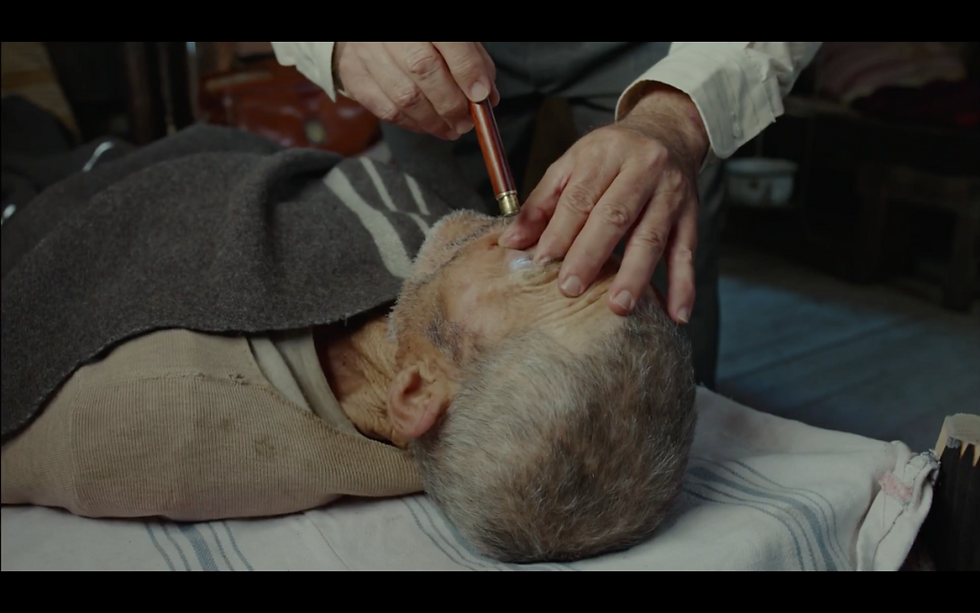
One book exerted a profound influence on the construction of this superficial story. French geologist François Ellenberger was once imprisoned in a concentration camp in Austria, yet he survived his ordeal. While confined in the camp, he was unable to work as a geologist, nor could he explore caves or anything else. The only thing he could do was explore himself through geological methods, examining the happy moments stored within his own memories. He embarked on an expedition inward into his own body, regarding his body as a mountain. This became the subject of the book he wrote after being released from the concentration camp, titled Le mystère de la mémoire.

Renato Berta's cinematography is breathtaking both from a purely aesthetic perspective and in terms of technical logistics. A one-kilometer-long fiber optic cable allowed him to adjust the camera aperture in real time from the ground, with some shots featuring no fewer than eight distinct aperture settings.
Deep within the cave, the frame begins in total darkness. The cavers’ flickering headlamps continuously reshape and alter the composition and sense of depth. Exterior shots follow an entirely opposing logic to those captured underground. The blackness dominating the frame always holds varying gradations of gray.
We venture into the bowels of the earth to free ourselves from anxiety over the passage of time. Cinema brings light into the darkness of the unknown, casting an elongated shadow in its wake.
In his critiques of Nazism, Bertolt Brecht repeatedly emphasized the concept of "order"—order stands as a symbol of imperfection. Conversely, we might argue that chaos signifies abundance. When the camera is placed in darkness, everything exists in a state of potentiality; once the team’s headlamps switch on, burning paper drifts down, and Berta remotely manipulates the camera’s intricate settings, the reality that emerges takes form as shadow.
From the perspective of media history, cinema’s descent into the cave can also be interpreted as a form of media self-rediscovery. Minerals are indispensable to media: from silver halides to silicon and gallium used in semiconductors, the extraction of these minerals creates a material foundation that precedes any media content itself. This constitutes a convergence of media history and geological history.
Accordingly, Frammartino noted after filming concluded that the cave itself perpetually lies outside the frame, a kind of darkness inherently hostile to the camera. Yet this invisible off-screen space constitutes its most fundamental essence.


*Survey the unknown, and map the boundaries of civilization
Through the displacement and parallax between the camera and cavers, we are able to break free from the claustrophobia of the first-person perspective and catch our breath. At times, the camera acts like a prophet, moving ahead of the explorers and waiting amid resolute, silent darkness; at other moments, it stays put, watching the cavers descend into pitch-black nothingness.
Cavers are melancholic souls. What they seek is not victory, but an endless string of failures—every completed endeavor ultimately culminates in a setback. For much of the runtime, the film centers on how the explorers coordinate their descent with meticulous caution, measuring the distances they travel using tape measures. When the fully mapped cave layout is revealed in the closing sequence, we are left with mixed emotions: an inescapable sense lingers that nature rejects human habitation within its caves. Cartography, one of the most intrusive forms of scientific inquiry, annexes uncharted territories into human dominion. Where knowledge extends its reach, it preemptively excludes nature that exists outside human history.

It is only at this moment that we recall that the vehicles of these Piedmontese speleologists were military vehicles backed by support from the Italian Army. Towering accelerationism points to hidden structures beneath infrastructure, underpinned by an entire history of resource geology and mineral extraction. On magazine pages set alight to gauge depth appear the faces of Richard Milhous Nixon, John Fitzgerald Kennedy and Sophia Loren. Serving as visual markers of their era, they also embody how consumer goods from the north were transported south, only to be discarded there.

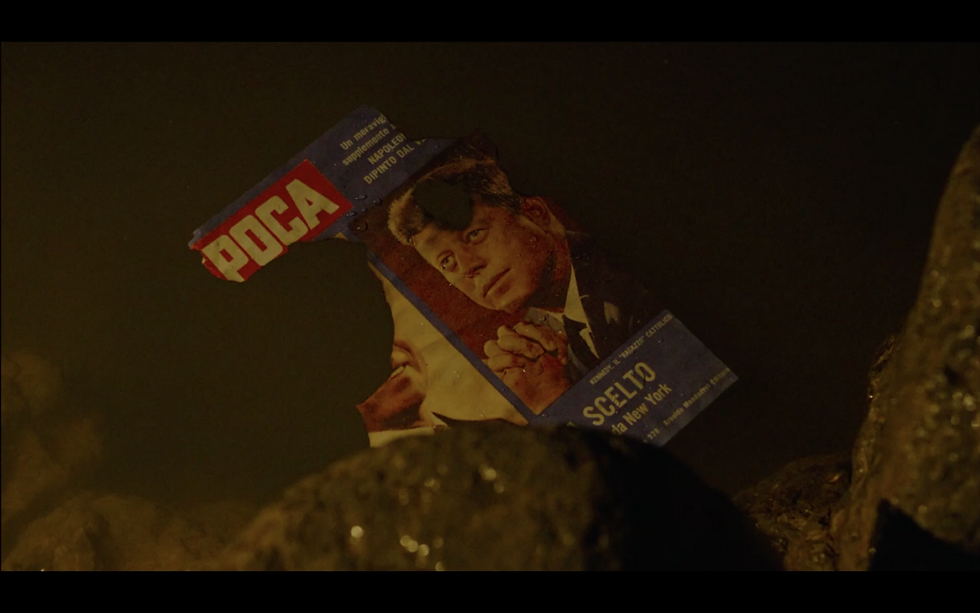

Similar natural environments can give rise to vastly different local experiences: one consists of perpetually evolving rural traditions, while the other embodies intellectual authority constructed through reterritorialization. The accomplishments of cartography mark the formation of a new landscape, which aligns with what David Harvey terms "creative destruction"—all that is solid comes under scrutiny and undergoes restructuring under the force of capital.
Evidently, the director has no intention of depicting nature with the unique poetics from the vantage point of romanticism. Frammartino’s naturalism likewise shows no preoccupation with human beings. Adopting an aesthetic will akin to that of a deity, he ultimately cultivates a viewing experience that integrates transcendence into ontological perception.
Admittedly, when we strain every nerve in pursuit of the infinite, what we attain remains nothing but concrete particulars: that stone hitting the ground, and a sigh echoing at the bottom of the cave in the end. Discovering concealed infinity within this bounded cave may be fraught with peril, yet it allows us to sustain enthusiasm for the world rather than being overwhelmed by suffering from the outset. Such a journey is perpetually unfolding along the passage of time.


*In the crevices of time, behold the eternity of the earth
After World War I, the question "Who does this world belong to?" became decisive: it concerned possession of all territories and state apparatuses across the earth’s surface, and was complemented by claims beneath the ground.
Following World War II, this original inquiry was supplanted by a new question: Who does time belong to? Irreversibly, time replaced space as the resource contested by mass media—its direction, density and rhythm. Symbols of thriving northern capitalism seized the attention of villagers in the Global South (we may observe that it is precisely at this moment that the entire soundtrack of a film is drowned out by television audio, with ambient surrounding sounds vanishing entirely). The time of herdsmen merges with natural rhythms, and the reverberation of a single cry erases the opposition between shadow and light. Speleologists, akin to Chronos (Χρόνος), the god of time venerated in Orphism, strive to transcend rational intellect, tracing the formative origins of all landforms.


Nevertheless, the geological chronicle still gives rise to an epistemological distortion: nature, treated as "evidence", fails to manifest continuous time. This divergence in temporality reveals itself explicitly at the film’s ending: after the cave cross-section is drawn, drifting mountain mist shrouds the landform, accompanied by the chant "Ah-oh, ah-oh, tei, tei, tei...". At this very moment, light assumes tangible form, and the inner spaces of the universe dissolve into one another. The echo of the shepherd’s call pierces death, and time comes into being amid the fading of all things.
The perspective at the conclusion ascends vertically upward from the heavy, weary underground, receding into a slow, overhead vantage point. It constitutes a kind of flight, standing in opposition to gravity. It embodies a lightweight nostalgia, born from the lameness of the real world.
Calabria, our mist-shrouded "unfinished land"—infinitely tiny yet infinitely immense—renders the great feats of this expedition nothing more than a coincidence nestled within a far larger temporal fissure.
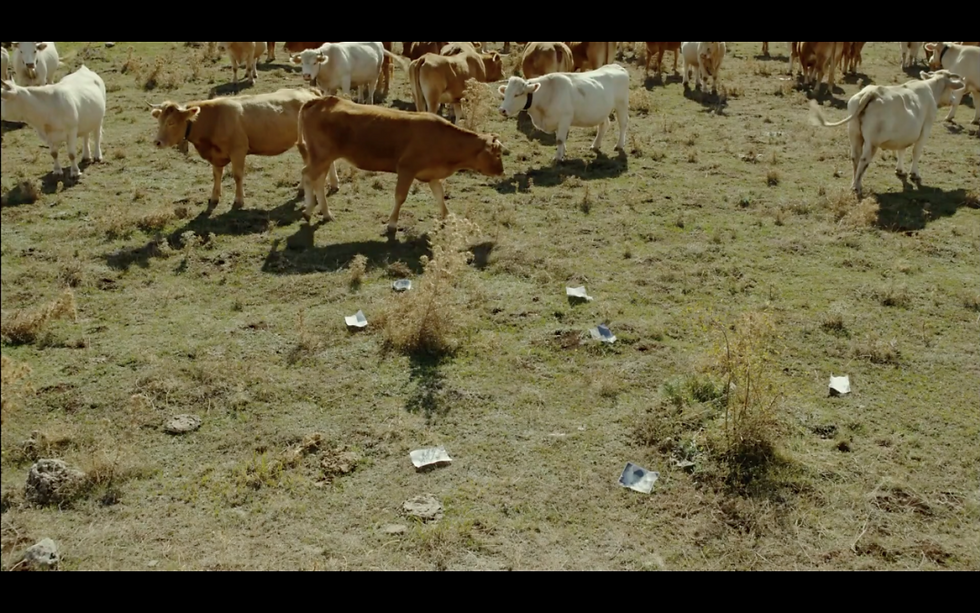


Image: From the Internet
Text: uki
Typesetting: Liu Ruiyan
Editor-in-Charge: Lu Xuanlong




Comments