
Marty the Supreme|Gradually Leveling Off Speed

[ the gradually leveling-off speed ]
The word "ping-pong". When we look at the form of this term, we can usually easily picture a game of table tennis, or more precisely, visualize its trajectory and shape—it is as if a back-and-forth rally is formed between the two characters. The incompleteness each character possesses drives them to collide with and draw toward one another. The ball/dot sustains the movements and intentions of both sides: it acts as a medium transmitting signals between them, and more importantly, as a tangible vessel storing all energy and meaning. At random moments, this word erupts, stretching this competitive back-and-forth match to encompass interpersonal interactions on a broader scale and even the motions of celestial bodies across the universe.

We are not sure whether Josh Safdie has ever encountered these two characters. Nevertheless, based on the foregoing description, the author’s attempt to draw a connection between the character layout in modern Chinese and Safdie’s thinking of visually presenting the fast-paced ping-pong game opens up an intriguing perspective: the interplay between the characters "ping" and "pang" resides in the action and reaction of all kinds of movements, while leaving cracks and omissions that steer movements toward unpredictable territory.
With critical delight and a sense of accountability, even at the risk of departing from the original intentions of the creator, is this practice not yet another race unfolding between myself and the creator, as well as the film itself? Under shot-reverse-shot editing, both sides endeavor to cross boundaries, break through the frame, and expand the visual world into a grand cosmic realm.
& Sales-driven initiative - Surpassing speed
Marty Supreme centers on an athlete with immense ambition and formidable talent in table tennis. Determined to achieve fame and success at all costs, he resorts to every trick and deception, cutting off and discarding all people and incidents that might hold him back, while exploiting every person and resource that could help him win championships to the fullest. For him, staged performances and fabricated narratives are the only things he can trust on his road to stardom, yet both are plainly hollow and illusory.
He is indeed an exceptional con artist. When we witness him coercing and manipulating his fellow players to secure the 700 US dollars his uncle promised him, or hear him sweet-talking a former actress over the phone to lure her to his elaborate romantic gesture, we marvel at his masterful command of constructing compelling, logically coherent stories and the seamless coordination between his various performances and fabricated tales. As audience members, we are persuaded and moved just like the targets of his sales pitches and storytelling. Unlike the characters, who feel a mix of anxiety and suspicion when being pitched by Marty, we are consistently convinced and even touched solely by his obsessive drive to chase his dreams, fame and fortune.
The faster his words rush forth and the more exaggerated and ridiculous his gestures become, the more intensely we perceive the fundamental urge to validate his own existence underlying this self-promotion, even amid our amusement and discomfort.


It was not until his match against Japanese competitor Endo that this fast-paced self-promotion ground to a halt. During this contest, one could distinctly sense Marty’s labored breathing and mounting anxiety, as if he stood at the center of the universe, with all preceding scenes depicting him subduing celestial bodies one by one, poised to radiate like the sun on the final stage and envelop every character and planet in his glow.
Yet just as self-promotion inherently harbors peril and emptiness, Marty himself is an empty star that fades from brilliant luminosity after a brief burst of nuclear fusion. All his ferocious will to survive that drove him earlier becomes utterly ridiculous in the wake of his defeat on the court. His self-promotional gestures are reduced to absurd theatrics. What once reshaped our perceptions and subverted our expectations amid the breakneck plot progression devolves into prefabricated content designed merely for amusement and catering to niche demands, calibrated to a moderate pace and narrative completeness.
In essence, Marty’s speed no longer conquers anyone. Ensnared within the massive spectacle of consumerism, his velocity is absorbed into a larger system. He participates in racing only as a replaceable component rather than a driving force. His speed ceases to outpace others and is repeatedly outmatched instead.
Still, Josh Safdie avoids letting the character spiral endlessly into bitter despair. Marty retains his fierce urge to validate his own existence. For this reason, he crudely turns down performance and promotional offers from wealthy financiers and pushes back against their dismissal of his dreams, even if this steers him toward cruder, more humble public stunts. Compared to the ideological posturing between American and Japanese sides, these alternative acts are far more compelling: playing table tennis against a sea lion, or wielding pots and pans as paddles. These moments are comical yet deeply grounded in ordinary life, offering inspiration for us to embrace everyday existence.


Following this approach of flexibly manipulating physical materials, Safdie devises an escape route for the characters amid our fast-paced, intense table tennis sequence. Just as defeat looms over Marty, a table tennis ball struck by Endo rolls into a dark corner, with the camera tracking its movement—a journey plunging into darkness and the unknown. Even the motion itself becomes shrouded in obscurity and uncertainty: while the players can roughly anticipate outcomes and trajectories on the court, they cannot predict the extended movement unfolding after those outcomes take place.
This shot embodies the most captivating hallmark of Safdie’s filmmaking: within high-speed movement and collisions, indeterminate and unforeseeable heterogeneous elements (both human and inanimate) intrude outside the causal chain of actions and pre-planned paths, alongside unintended behavioral byproducts beyond intended results. All of these infuse boundless potential into the footage.

& Chasing motion - dangerous speed
After losing the match, Marty remained stubbornly determined to prove himself in the subsequent competition in Tokyo and reverse his status as a loser. To this end, he embarked on a side quest to raise money for travel expenses. He kept trying to promote himself over and over, yet unlike his arrogance and self-assurance before the match, Marty kept landing in embarrassing predicaments. He was even cheated and dragged down by others, or struck by sudden disasters—we will never forget how his leisurely, relaxed bath scene abruptly collapsed into a perilous near-death situation.

Right after this scene, following a moment akin to a ping-pong ball rolling into a dark corner, Marty officially begins his pursuit. He suddenly comes into seed money, and together with his friend, they play off each other at a casino to successfully swindle a large sum of money. Overwhelmed by the joy and excitement of achieving their goal, Marty and his friend recklessly match the speed of a car, experiencing extreme velocity alongside the vehicle and its material momentum. This is the most perilous moment in the entire film, which consequently triggers a violent explosion. Only the ping-pong ball itself can contain and absorb this built-up destructive energy; in this sequence, it transforms into a dog fleeing toward an unknown distance.


Just as Marty seems poised for success, he always encounters the most terrifying dangers right after a fleeting moment of elation—the solitary elderly resident who comes home unexpectedly, patrolling police officers, threatening phone calls from the dog’s owner... All these forces pose threats to Marty, closing in rapidly to stop him from achieving his goal.
Indeed, it is much like a table tennis match: the ball you strike will inevitably rebound from an unpredictable spot it lands on; otherwise, the game cannot go forward. Numerous variables have long been foreshadowed and set up in advance.
When it comes to the stark differences between Marty Supreme and the Safdie brothers’ earlier works, the key distinction lies in that Marty Supreme is firmly framed as a conventional inspirational sports drama in terms of plot. Every character and narrative thread revolves solely around Marty as the central anchor, serving as an overarching structural backbone that holds the entire film together. In contrast, the plots of Uncut Gems and Good Time spiral along entirely unpredictable trajectories. Whether it is the compulsive gambling in Uncut Gems or the criminal manhunt and escape in Good Time, their storylines unfold wildly and unrestrainedly. After characters cross paths and clash with one another, they end up falling back to where they started.
If the visual universes of those two films resemble interlocking, sharply faceted diamond crystals reflecting light off each other, Uncut Gems Aficionado ultimately constitutes a structured, ordered universe confined strictly within the bounds of a table tennis court.

& Act of betrayal - steady speed
Marty’s embodiment as a reference to the American Dream inevitably propels him back into confrontations and tentative contests against capital. Thus, after repeated fictional dramatizations, Marty ultimately fails to achieve his goal through his own pursuit; instead, he opportunistically surrenders his dignity and fate to capitalists in a performative gesture.
This final match is a meticulously staged performance, with its rhetoric, tone and pacing seemingly firmly controlled by international sports governing bodies and sponsors. The construction of the arena and arrangement of spectator stands are manipulated by a massive capitalist apparatus. The line "You have no power here" appears to rigidly confine individuals to their predetermined places.

For Marty, the center of the stage where he stands is both the most tightly controlled space and the ideal platform to promote himself and send narrative signals. All eyes converge on this single spot, anticipating that the athletes on court can immerse them in the rapid pace unique to table tennis competitions. Even though spectators hold different sides and positions, wear varied outfits, and span all ages and genders, they are constantly craving unadulterated entertainment.
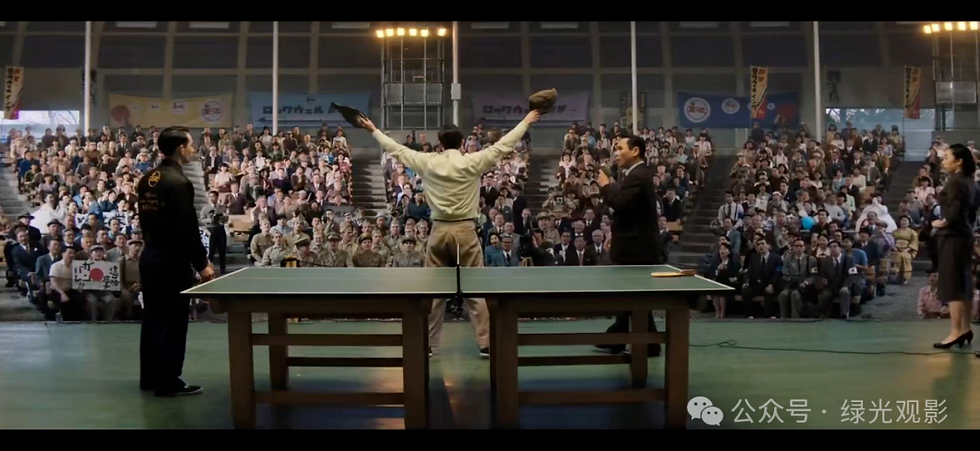
Accordingly, Marty skillfully delivered a meta-performance on stage—a speech-style exposé of his own match-fixing behavior just moments earlier. The audience was quickly swayed and swept up by his words. When one person shouted, "I want to see a real competition," the outcry and resolute stance spread like a virus all around the stage. We witness how the ordered space constructed by financiers and leaders of the international sports committee instantly transforms into a venue for pure entertainment.
Safdie strikes a resonant chord here: human beings are capable of freely reshaping the spatial environment they inhabit at any given moment. In other words, physical space always retains openings for people to step in, infusing its rigid exterior with power and emotion. Once the genuine competition/performance commences, the audience is finally able to purge their joy tainted by ideological influences, devoting their minds and bodies wholeheartedly to the pace set by the two performers/athletes on stage.
Notably, Safdie moderately adjusts the dramatic tension of scene blocking and the tempo of shifts when depicting this match. The sequence is predominantly composed of medium and long shots, with the pacing and tone of editing and sound effects turning gentle and unhurried. Footage of the stage and auditorium is allocated nearly equal runtime. For a fleeting moment, it feels as though this match could go on indefinitely. Anticipation for victory pales in comparison to the experience of swinging back and forth across the table alongside the ping-pong ball, embracing the joy of connection amid tense yet steady rhythm.

I have often imagined the film ending with the afterimage of a table tennis ball spinning through the air, representing a bold venture of fully plunging into an unknown, mysterious and perilous material world alongside a companion. A comparable sensation can be found in the glittering facets of the diamond in Uncut Gems, yet in that story we are clearly left to venture deep inside the diamond all alone. By contrast, Marty Supreme draws others into exploring the darkness inherent in matter together.
Regrettably, Marty Supreme is bound to fulfill its predetermined narrative destiny: Marty has to reach the shores of victory in the end. The trust built between Marty and Endo is sanitized into nothing more than Marty’s well wishes for his future matches. Sponsors and the sports council ultimately reclaim control of the spotlight and abandon Marty in Japan. Most tedious of all is the prospect that Marty will return to his hometown, reunite with his childhood sweetheart, and spend the rest of his life "settling down" with their children.

It is ultimately hard for us to imagine Marty ever "settling down". After all, what has always captivated us is his frantic pursuit of speed and his desire to perform in extraordinary ways. When everything settles into a steady, sluggish routine, when this inherently self-destructive vessel carrying the American Dream is tamed by capital into a compliant cog in the machine, our sense of loss stems not merely from the inevitable exhaustion after constant physical and mental overexertion. It also arises from an existential emptiness we fall into once our past is denied and erased entirely.
We can easily picture Marty in the future as a diligent, amiable top salesperson hawking his own products. He would rack his brains to package goods so they seem worth their price, or even a bargain, just like the top live-stream sales influencers flooding major social media platforms today. We would still be drawn to him and buy whatever he pitches, yet we would no longer perceive anything beyond the merchandise in the stories he spins, his tone, and his speaking rhythm. Gone would be his intense will to exist, leaving only commodities finely calibrated between pretense and commercial value.
Surprisingly, Marty’s persona seems to have gained an alternative future in China. He roams city streets, trying to sell the film to passersby in a listless, mediocre manner only to be ignored by everyone. He also sells fermented bean curd with a distinct personality and a slightly pushy tone. While this is merely an adaptation of a popular mainland internet meme, we at least get to see an engaging individual in this performance. Moreover, he does not seem to care much about his product; the clumsy, ridiculous way he cuts fermented bean curd with a tennis racket suggests the joy of performing itself is what drives him. Perhaps this is exactly the future we have hoped for for Marty Supreme…
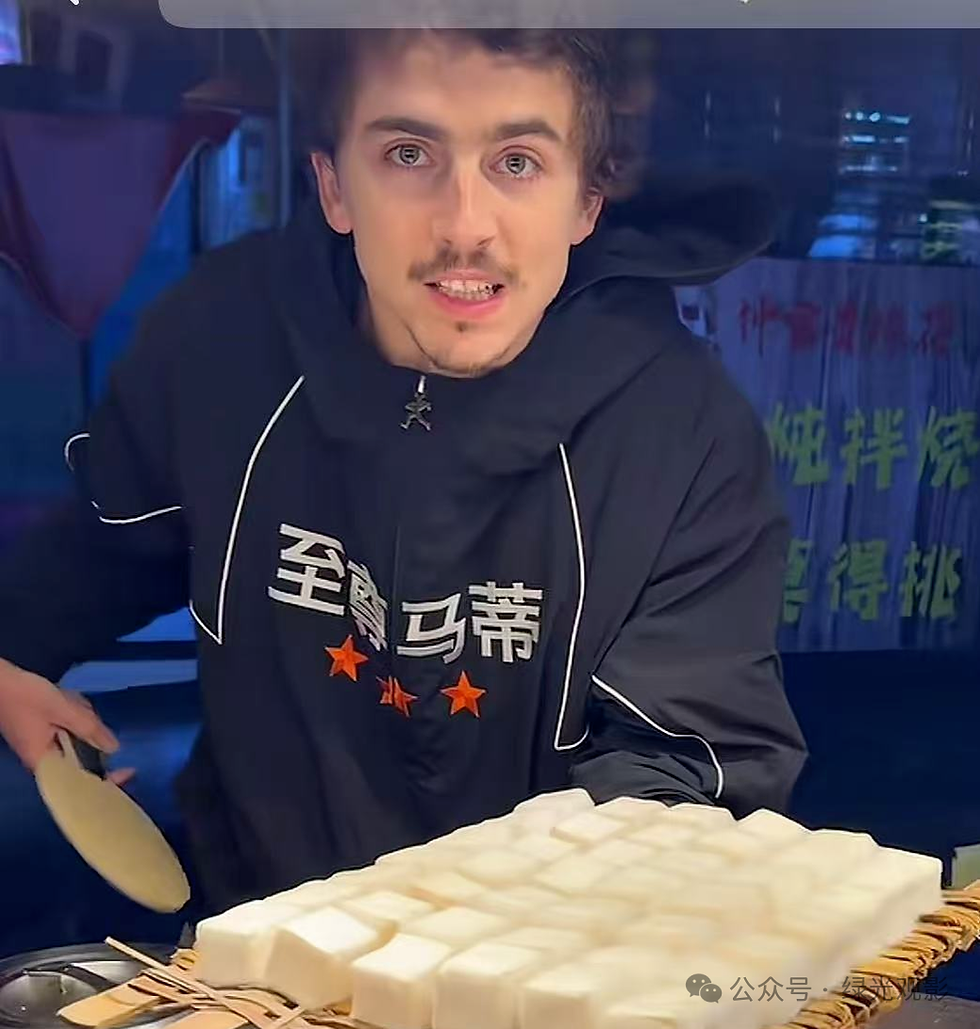
Image: From the Internet
Text: Antoine
Typesetting: Jing Xi
Editor-in-Charge: Lu Xuanlong




Comments