
Colony Cannes Film Review|Spectacle of Combat and Sacrifice

*The Spectacle of Battle and Sacrifice
"This will undoubtedly be the most commercially oriented film I have ever made so far... I am trying to draw on the strengths of Train To Busan and Hellbound to create an engaging movie." — Yeon Sang-ho |
#Box office and word of mouth
As of June 1, 2026, the cumulative domestic audience admissions for Colony in South Korea have exceeded 3.47 million, ranking second on the annual domestic box office chart. It holds a Douban rating of 6.5, a CGV Golden Egg Index of 89%, and an approximate Rotten Tomatoes score of 70%, with its overall reputation falling between Train to Busan and Peninsula.
Overall, Colony has proven to be a commercial hit with lukewarm critical reception. Reviews from professional media are rather muted, while user ratings on Douban are sharply polarized and particularly harsh. Supporters argue that the film expands the genre boundaries of zombie movies and represents a new pinnacle for Yeon Sang-ho. Critics, however, claim that nearly every new work he directs flops, asserting that its exploration of human nature is far less profound than that of Train to Busan.

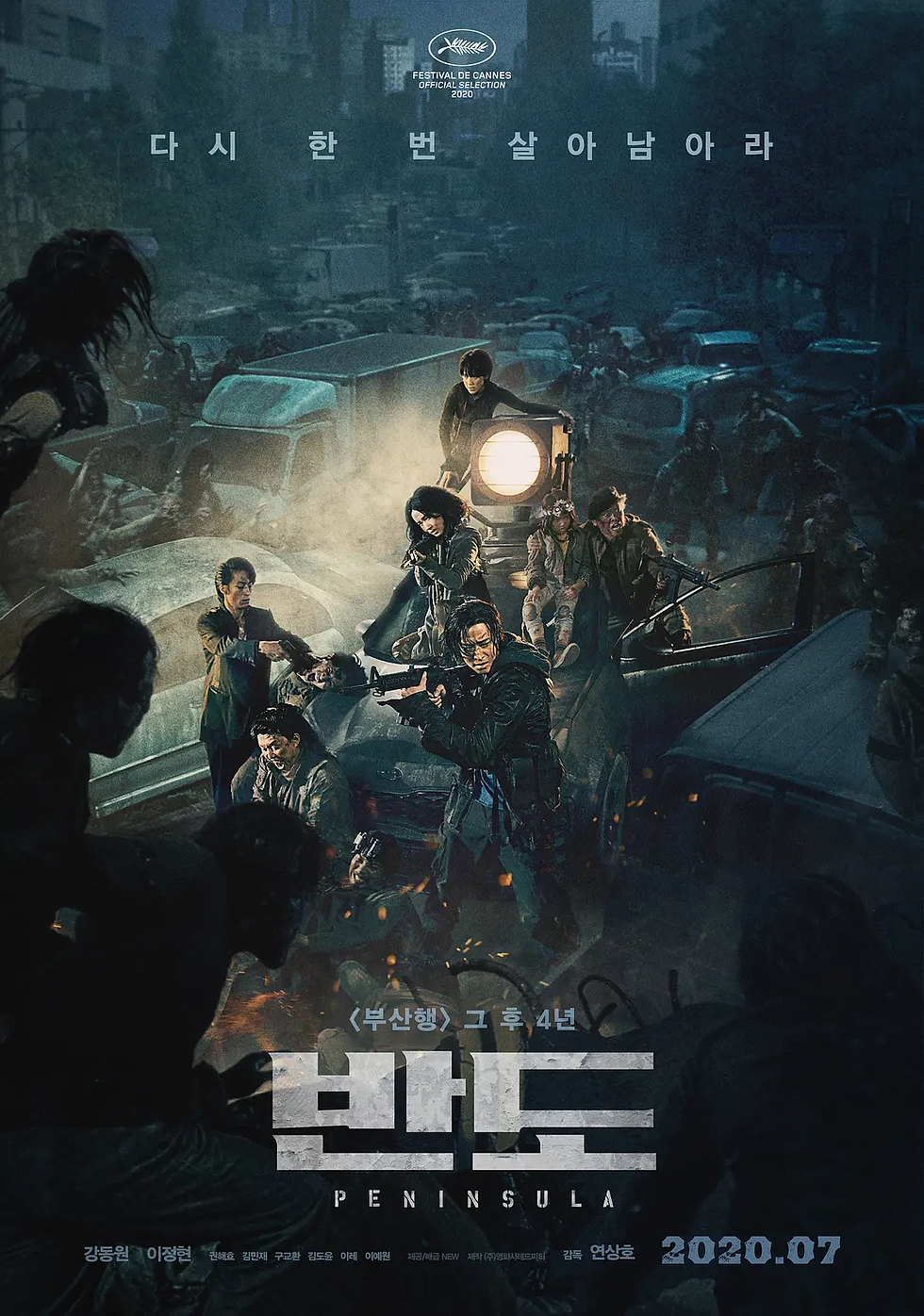
Nevertheless, Colony continues the recurring themes of Yeon Sang-ho’s zombie franchise. The virus spreads outward from enclosed spaces, and family bonds serve not only as the spiritual motivation for survival but also as an emotional anchor that tugs at heartstrings during moments of sacrifice. The ethical question of "who ought to sacrifice themselves to save others" lingers throughout the story, while satire targeting the inefficiency of South Korea’s administrative bodies lies beneath the zombie genre framework. These elements echo one another, collectively forming the framework of the social issues reflected in the film.
#The "Humiliation Style" in the Era of Artificial Intelligence? An Alternative Interpretation of the Zombie Form
The zombie archetype in Colony has gained new interpretative dimensions in the age of artificial intelligence. Julia Kristeva, a Bulgarian-born French thinker and psychoanalyst, argued in her 1980 work *Powers of Horror: An Essay on Abjection* that for individual human beings to establish an independent subjectivity and integrate into social order, they must constantly demarcate the boundary between the internal and the external. They expel primitive, untamed and unassimilable entities, namely the "abject", from the realm of the self.
Yet the abject never truly vanishes. It lingers persistently, continuously assaulting the subject’s sense of boundaries through visceral revulsion and terror. Abjection often arises at liminal zones: between life and death, between the human and the non-human. The walking corpse—the zombie—resides precisely on this dividing line, serving as the most tangible physical embodiment of abjection.

The zombie setup in Colony precisely connects this theory to society’s collective anxiety about artificial intelligence in the modern era: the infected in the film possess human-like appearances, can evolve independently, mimic human behaviors, and share information with one another in real time, serving as a tangible projection of humanity’s fears toward AI.
Their existence lays bare the potential for ghostly mass surveillance and the expansion of authoritarian power. Technologies such as facial recognition, behavioral prediction and emotional analysis turn every human movement and gesture into raw material feeding data models. Are the movement trajectories of survivors captured in surveillance footage controlled by humans, or have they already been received and relayed by another collective, mechanical set of eyes? This ambiguity constitutes the core metaphor embodied by the zombie figure in this context.
#Gendered Political Writing
Beyond the astute observations about the era of artificial intelligence mentioned above, another delightful highlight of Colony lies in its creation of a cohort of female characters endowed with intellectual depth and complex moral dimensions, through which it makes veiled critiques of gender politics within the tech industry and academic circles.
Academia at South Korean universities remains male-dominated to this day. Female professors often find themselves ostracized for being outspoken, suffer slow career advancement, and frequently have their research outputs appropriated by male scholars. Kwon Se-jeong, portrayed by Jun Ji-hyun, embodies all these predicaments; this also marks her return to the big screen after an eleven-year hiatus following her role in the 2015 film Assassination.
Se-jeong is a professor of bioengineering who was denied contract renewal for standing up for justice and confronting her department head head-on. She is also the pivotal figure who exposes the father of the antagonist Seo Young-cheol for exploiting student labor. Traits such as stubbornness, unemployment, and marginalization by institutional systems converge on this female scholar, serving as the film’s commentary on gender politics in academia.

Yet in its action sequences, Colony takes an unexpected approach, portraying Sejeong’s agency in a decidedly positive light. In moments of crisis, her academic expertise and status as a professor naturally grant her the authority to command the "battle". Confronted with hordes of zombies that share intelligence via pheromones and keep evolving, Sejeong draws on her knowledge of the Ant Mill phenomenon.
This phenomenon illustrates a collective predicament: ants lack vision, and once they lose the pheromone trail laid by a leader, they will march in endless circles until they collapse from exhaustion. Similarly, the evolved zombies equipped with sensory and positioning capabilities will abruptly regress to a primitive crawling state the moment their pheromone chain is broken.
Building on this principle, Sejeong devises a string of interconnected tactical plans: she coats the lead zombie with a mycelium suit to artificially trigger an ant mill and buy time for the group to escape. While Youngcheol keeps manipulating the zombie horde’s evolution, she activates the building’s automatic sprinkler system to disrupt the slime mold network and scramble the zombies’ senses.
She is also the first to suggest blinding Youngcheol. By turning him into a "living vaccine" controlled by the survivors, she blocks his ability to relay the survivors’ locations to the horde through visual synchronization. Sejeong’s sequence of maneuvers translates female intellectual prowess into concrete survival tactics, forming the most thrilling narrative arc of the film—and this sense of excitement is crafted entirely within the conventions of commercial genre filmmaking.
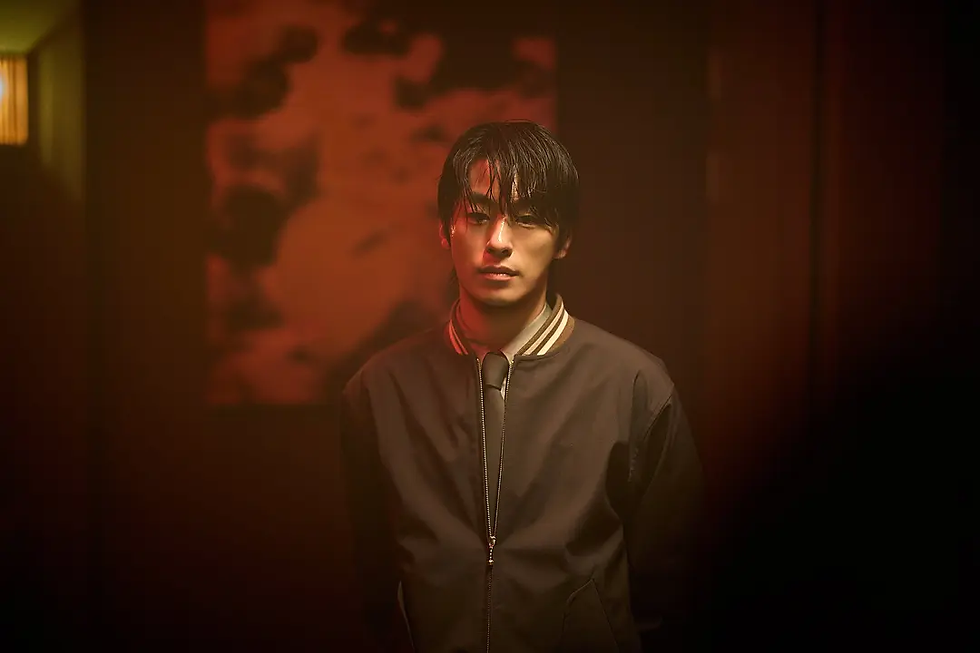
To a certain extent, this also forms the root of criticism from detractors. The film has an extremely predictable narrative pace. The cowardice and selfishness of a female perpetrator of school bullying, coupled with the dereliction of duty of a police officer, bear almost all internal negative conflicts within the group of survivors, resulting in one-dimensional characters. Yeon Sang-ho opted for the laziest way to deal with these villains—having all of them get devoured by zombies. After the supporting characters in Colony are eliminated one after another, audiences can nearly take it for granted that Se-jeong will survive, and this certainty undermines the suspense of the film itself.
#Female group portrait
Outside the building, Seol-hee (played by Shin Hyun-bin), a female professor, takes charge of on-site command for the police force. She is crucial to containing the spread of the epidemic and has volunteered to bear public accountability if experts make erroneous judgments. There exists a subtle personal connection between the two professors: Se-jeong is the ex-wife of Kyu-sung (played by Go Soo), while Seol-hee is his current wife. At the start of the film, Kyu-sung helps Se-jeong land a job, only to be killed shortly afterward by a mutated infected person.
By doing this, Yeon Sang-ho eliminates the potential for tangled romantic drama and shifts the focus to the collaboration between the two female professors. Seol-hee provides remote support from the command tent, whereas Se-jeong fights amid hordes of corpses. Working one inside and the other outside, they form a formidable alliance.

Nevertheless, while Yeon Sang-ho’s portrayal of the two female professors burying the hatchet and assisting each other remotely echoes contemporary audiences’ expectation for narratives of female solidarity, it fails to construct convincing emotional logic: the film offers barely any credible explanation of where their rift originated or how it was resolved.
This harmonious mutual aid thus becomes a preordained gesture. Yeon Sang-ho is clearly aware that female solidarity is well-received by modern audiences, yet he fails to endow it with genuine emotional substance. More critically, as the film strives to highlight the dedication and sense of responsibility the two professors demonstrate toward the public and society, it barely touches upon their respective family circumstances and inner emotional lives. The thorough depiction of their public lives stands in stark contrast to the conspicuous absence of their private spheres.

This kind of absence is embodied in another important female character. Hyun-hee (played by Kim Shin-rok), who has limited mobility, deliberately gives wrong directions at the last minute to lead her younger brother to safety before being killed by zombies. Apart from labeling her as an "eldest sister" and a "person with a disability", Yeon Sang-ho barely provides any further backstory for her, thus elaborately constructing a sacrifice shrouded in strong moral glory.
The combination of physical disability, eldest sister identity and self-sacrifice makes this tear-jerking scene questionable. Is this an unconscious glorification of "disabled women sacrificing their bodies to save others"? Such unconscious bias may be more worthy of vigilance than any deliberate offense.
The AI metaphor embodied by the horde of corpses is sharply insightful, the female professor’s intellect shines brilliantly, survival hinges on mutual aid, and villains deserve to perish. Moments in the film that could have probed the complexities of human nature seem to regress into spectacles of combat and sacrifice.
The Colony takes a remarkably contemporary leap forward in terms of scene orchestration and innovative premise design, yet can its commercial framework truly accommodate the profound inquiries into human nature that it seeks to pose?

Image: From the Internet
Author: Yuanye Jellyfish
Typesetting: Lu Xuanlong
Editor-in-Charge: Lu Xuanlong




Comments