
The Virtual Greenhouse: Zoom in, Zoom out
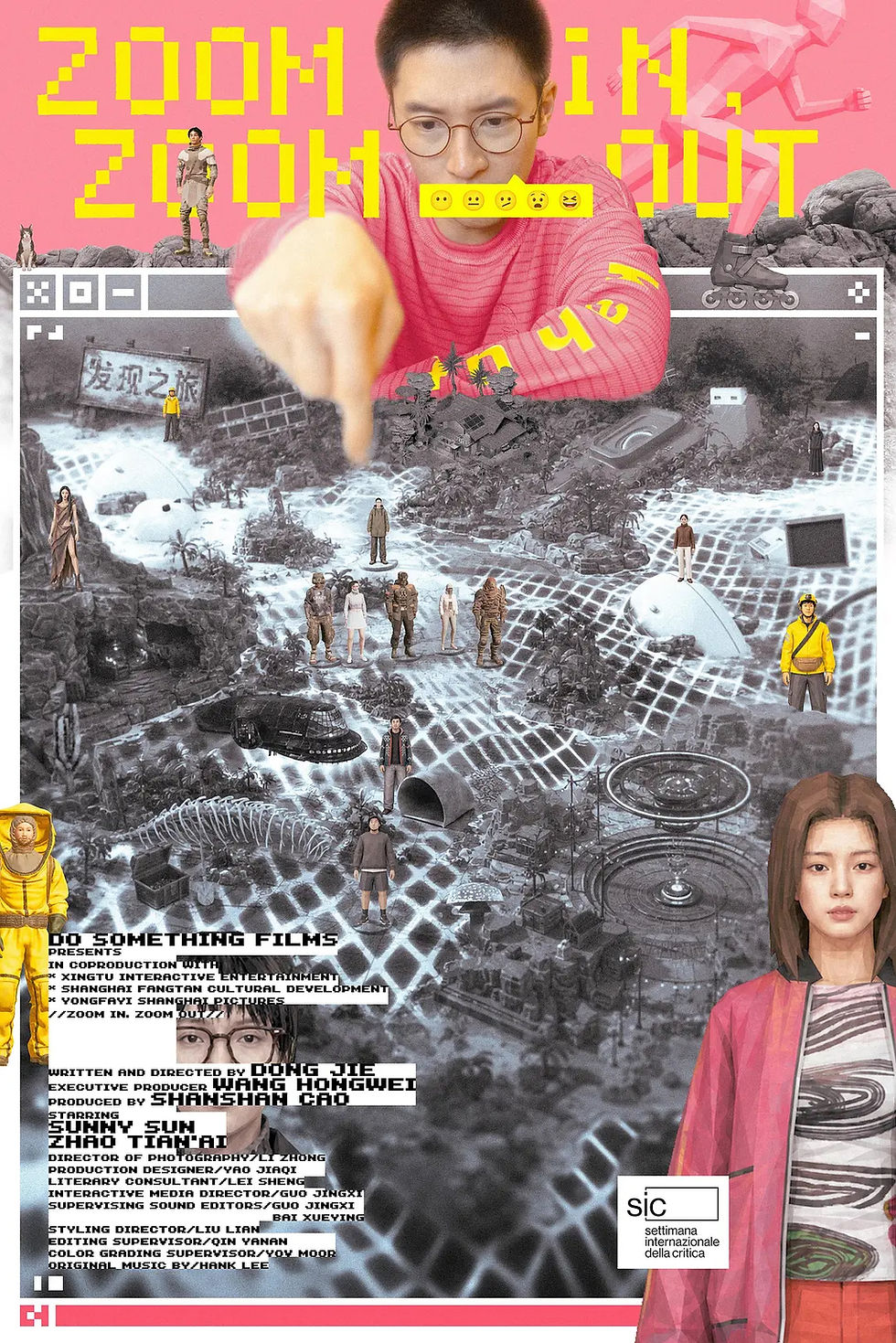
Zoom in, Zoom out is perhaps the recent Sinophone film that most unreservedly embraces pure fiction. Within its visual frame, the image undergoes a total invasion—the game, a new phenomenon and a new world, directly imparts an uncanny temperament to the image's otherwise stable narrative form. As a rare Chinese independent feature echoing the avant-garde "machinima" wave sweeping foreign film cultures, it confronts cinephiles with an unmistakable sense of surprise at the level of visual iconography and atmosphere. We might anticipate a radically different cinematic paradigm—a resurrected manifestation of that dead art form we call "New Cinema"—yet as we press forward along this trail of pleasurable strangeness, we gradually realize that fiction cannot escape being overwritten by reality. Perhaps this is a style we might call realism, a fundamental palette of Chinese cinema that cinephiles have long debated, praised, and critiqued.

The premise of Zoom in, Zoom out is deceptively simple. A game engineer suddenly vanishes without a trace. His roommate, old college friend, and colleague (played by Sun Yang) is the first to notice his absence. Driven by a mix of unsaid motives or sheer ennui, he sets off to track the whereabouts of this friend he had long neglected—trying to uncover where he went and what those around him know. He eventually learns that his friend has passed away, though a piece of his soul appears to linger within the dimensional space of the video game. Through his investigation, Sun Yang’s character slowly recognizes the significance of those around him, ultimately stepping toward a new life. In short, it is a story of rediscovering and learning to value the people and environments close at hand. Such a synopsis naturally evokes social-realist films attuned to humanistic care, rather than playful, materiality-driven works like Dead Diamonds Reflection that hurtle toward destruction through the shifting flux of matter.
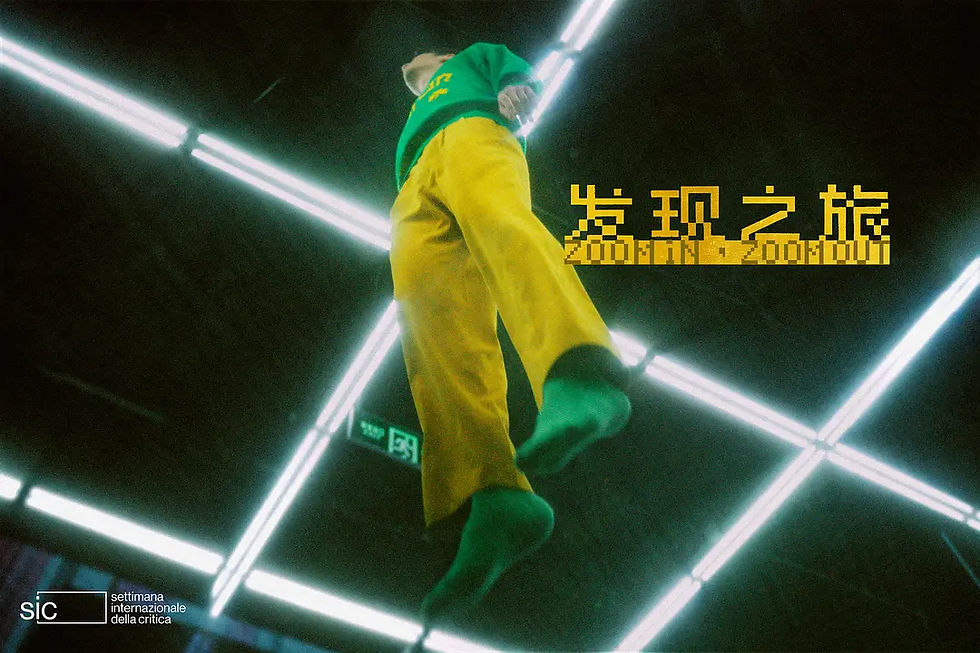
The environments traversed by Sun Yang’s protagonist are perpetually intruded upon by unmoored viewpoints or anomalous figures. The film opens with Sun Yang on the balcony of an office high-rise, looking down at an enigmatic scene. Director Dong Jie uses a split-screen technique to place the subject and the observer onto the very same frame. Immediately after, the perspective shifts to the eye-level street outside: self-evidently, seeing and being seen become blurred together through the instability of the point of view. Later, an unremarkable scene of daily life is suddenly disrupted by a skateboarder clad entirely in green; when Sun Yang attempts to focus on this anomaly, it vanishes in a flash behind an obstruction. In a sex scene, the image loses focus and drifts, as if the characters are decomposed into countless micro-particles—resembling virtual entities sculpted by the underlying code of a game engine. With these abrupt, unvarnished visual strategies, Dong Jie attempts to conflate the real world with the virtual space of the game. It is a commendable endeavor, one that prompts the viewer to anticipate the fluid state of the world to come with an anxious thrill.

Yet, the demand to care for the characters stands stubbornly in the way. Dong Jie, I suspect, makes the same choice as the friend who met an accidental death in the film: driven by an overwhelming moral anxiety in the face of another's misfortune, he undertakes strongly motivated actions. After constructing a domain where the virtual game world and reality intertwine, Zoom in, Zoom out hurries onto a path of mourning to uncover the friend's cause of death.
This is by no means a rejection of such overt moral impulses. When we follow Sun Yang to learn about the life of an optimistic delivery driver, watching the vlogs of his daily rounds, how could we not be moved by his spirit, or mourn his subsequent sudden death? At the film's climax, seeing the images of this driver's life planted along the perimeters of the game world affirms an inescapable truth: the virtual ought to, and ultimately must, serve the real. The virtual is not a boundless dispersion of dreams, but an extension of reality. Thus, Dong Jie abandons the avant-garde wave he initially pursued, returning to a grounded, unpretentious humanism.
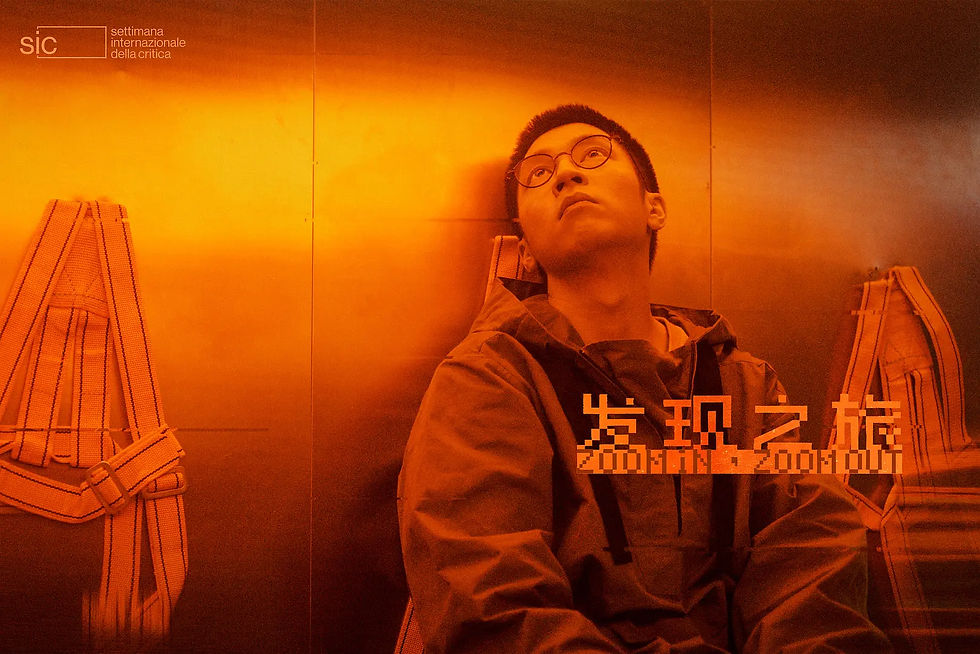
I wish to unpack this judgment through a video game mechanic featured in the film. On several occasions, as Sun Yang controls his avatar, his female netizen guide teaches him to use teleportation mechanics to instantly leap between locations—such as to her side or back to his own home. Teleportation signifies spatial leaps, or rather, the rupture and instant metamorphosis of situations. While a game world can be constructed on a continuous, unified topography, its true fascination lies in how disparate game spaces mutate and transmute rapidly along a compressed timeline. Zoom in, Zoom out frequently uses spatial estrangement to convey the illusory nature of reality and the psychological plights of its characters. Had the characters remained enigmatic, the uncanny quality of the space would not have dissolved under the weight of psychological representation. But as the characters flesh out—as the real-world dilemmas of Sun Yang and the female netizen become explicit through their accounts of the past and their mental states—the playful intrigue of the game loses ground, surrendering the virtual to a concrete process of personal healing.

In the game world, the deceased friend's house is rendered with rich details, yet the director directs our gaze only to real-world photographs, a diary, and a shovel (which also finds its physical counterpart in the real world). Had we been permitted to look closer, or to experience the eternal pulsation of temporality on a virtual beach, the virtual might have escaped the grip of reality. The map merchant at the film's end resembles a tombstone for the lost friend. But why accept a static presence when, within a virtual world, one could indulge in the luxury of creating a continued, living existence?
Kiyoshi Kurosawa is another auteur deeply enamored with games. Whether in Pulse (Kairo) or Loft, Kurosawa never stops playing; he continuously adventures through infinite, uncharted realms. If death must arrive, if psychological inquiry must solve the world’s mysteries, then only ghosts can sustain the enigma. Ghosts carry not only the secrets of the dead, but also the hopes for the living's future. Kurosawa does not aim to create "game imagery" per se, yet he relentlessly severs stable spaces, embedding the uncanny within spatial perception and accommodating explosive temporality within a single edit.

Director Dong Jie may lack Kurosawa's audacity and tenacity, but one still senses a sincere warmth in his images. The film contains a precious mid-section scene: the deceased friend's sister and mother arrive to pack up his belongings, and Sun Yang comes to ask about his friend's situation. Out of a protective instinct, the sister informs Sun Yang of her brother's death via WeChat messages. Dong Jie stages this scene through alternating shot-reverse shots; in the background of the sister's over-the-shoulder shot, we can faintly see the mother packing. What is simulated here is not merely an exchange between two people, but a collision between two smartphones—two distinct virtual spaces.
Here, the director offers a poignant tribute to the virtual medium. While the shift in media cruelly detaches characters from the tactile world, it simultaneously builds an isolated greenhouse for the individual. Its sole function here is protection: it does not hinder communication, but opens up entirely new virtual worlds for exploration. Even if Dong Jie’s virtual world eventually exhausts its reach, its inherently warm nature remains something worth protecting and carrying forward.
Comments