
Updated: Jul 20
Rifts in Perception: Hirokazu Kore-eda’s The Sheep in the Box

Today, we find ourselves in an era where discussing AI has become an absolute necessity. But why must we? Whether driven by an instrumental rationality aiming to maximize the potential of this novel technology within the high-speed machinery of modern society, or by an existential threat that demands protective measures to declare our sovereignty over life as artificial intelligence increasingly encroaches upon every facet of human existence—these pressing issues bear down on us with relentless velocity. This unbearable reality is cleverly cloaked in the grand garb of human morality and rational consciousness, and its mysterious, coercive nature is painted as a monumental duty. In doing so, we unconsciously validate and perfect the reality before us: an entity whose outer form resembles our own, its terrifying threat molded into human shape. All human vices can be projected onto this chaotic mass, and the dreams it carries can only be the far shores of human reach, rather than something truly unimaginable. In his latest film exploring the impact of AI technology on the human family, The Sheep in the Box, Hirokazu Kore-eda finds himself deeply entangled in this exact, awkward predicament.

The Sheep in the Box adopts a narrative archetype that has become a classic trope in AI discourse: when faced with the loss of a loved one, technology offers humanity a second chance, allowing the living to reunite with and accompany the deceased, who in turn receives a second life. Through new technologies like artificial intelligence, humanity seemingly triumphs over the barrier of death, extending the branches of civilization to life's ultimate boundary. Yet, putting aside the insurmountable logic of natural life, on a metaphysical level, can a chunk of iron or a body endowed with memory truly become the person who died?
Obviously not. When waking up from a brief afternoon nap on a park bench, is the lush green that floods our living eyes the same "green" perceived by that inorganic, organized body? Ultimately, the only thing capable of unifying these two vastly different entities is the sorrowful gaze cast upon them both. We thus realize that artificial intelligence has become a ritual of mourning. Its look of similarity is merely a mask placed over it by the living; beneath this mask lies nothing but a hollow object.
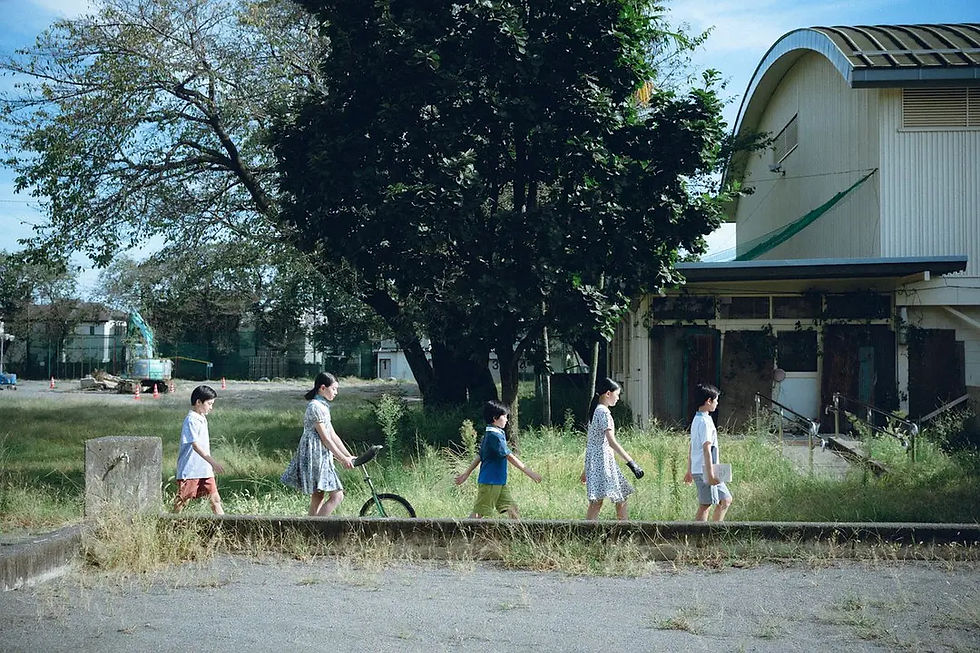
Kore-eda very candidly embraces this theme of mourning, much like the deeply moving family bonds in his previous films—even those fragile families formed out of the sheer will to survive, as in Shoplifters, which are enveloped in the director's steadfast gaze and passed on to the audience. Throughout Kore-eda's filmography, we indeed see a heartfelt pursuit of family values and emotional connection. This has proved highly effective, and often comforting, so long as it remained untouched by any radically heterogeneous individual. However, once confronted with an absolute, alien existence—as in The Sheep in the Box, where the android son, Sho, faces this mourning sentiment that is completely foreign to its being—the android's responses and actions become strikingly violent.
& Divergent Routines
When the android Sho arrives at his new home, he occasionally displays a side that leaves his human parents utterly astonished. After reading a subway manual, Sho stares intently at a passing train, and a steady stream of words begins to flow from his mouth—all of them names of subway stations. When the mother, played by Haruka Ayase, discovers this behavior, the curious, subtle look of bewilderment on her face punctuates our own perception. These words, composed of long, drawn-out notes and triggered by the motion of the train, seem to force a necessary perspective on how we view this body so different from ours: he is not human, and the world before his eyes is not the world before ours. Later, we see Kore-eda repeatedly forced to confront the intrusion of this perspective, and he accepts these alien moments—whether when the child faces danger and needs medical attention, when he needs to eat, or at bedtime... These moments are scattered throughout the tender narrative chain, acting as warnings that eventually banish the android Sho from a home where he does not belong.
& Building a New Home
On the human parents' side, Haruka Ayase grows increasingly bewildered by her decision to raise the android Sho, while the father, played by Daigo, sinks into helpless despair when trying to retrieve memories of the accident from Sho. Finally, upon discovering Sho's autonomous behavior, they take the final step of mourning: forgetting. On Sho's side, he finds his own companions. However, these companions are completely different from him: while Sho is a cherished child in a wealthy household, most of his peers are abandoned android children who have fled abusive foster human families. Here, we can discern a familiar motif—the abandoned child. Is this not one of Kore-eda's most frequently explored themes? Through this motif, he typically guides us toward the establishment of a new kind of family—specifically, a family of mutual care that is bound not by defined social structures, but by unbreakable emotional connections. In The Sheep in the Box, this new family is founded by Sho, who possesses both a free body and free will. Kore-eda even assigns Ayase's character the profession of an architect to provide a physical family space, introducing a narrative subplot where she designs a brand-new house. Consequently, Sho, who babbles and learns in his mother's shadow, naturally inherits this architectural design capability, constructing their respective stable spaces even as their emotional paths diverge.

Putting aside the clunky and contrived nature of this screenwriting device, Kore-eda infuses the process of inheriting this craft with an overflowing, sentimental warmth. Yet, this inundation of emotion has never felt so suffocating. The boundaries so clearly demarcated by their divergent perceptions are easily abandoned and trampled upon. The android is forced to conceal its unimaginable inner self beneath a recognizable human facade, and the situation engineered through this approach leaves us with only one dominant emotion: a mother bidding farewell to her deceased child.
When we watch characters in Yasujiro Ozu's films gaze into the invisible distance, we feel far more than a sorrowful farewell. Ozu's characters always stand tall and grounded, and their immutable composure mirrors the physical world around them. Ozu embeds emotion within a hard, material reality, yet this emotion never alters the appearance of objects; they remain bright, and the objects never respond to the characters' feelings—only the varying speed of the flowing water persists. In contrast, at the end of this film, Sho caresses a large tree—what a sticky, disingenuous gesture! Only an excessively mournful naturalist would dare impose such a self-satisfied action on a newly created child. Soon after, his companions begin to gather around the tree, transmitting the deceased's farewell to Ayase through their communion with the object, after which Ayase reveals an unprecedented smile—a sorrowful yet mutually understanding smile. Consequently, the final shot-reverse-shot plays out like a mirror ritual. Objects never possess their own shape; they are merely transit stations or transmission media for inner voices. The alien, physical cores of the android children serve as nothing more than a platform for the farewell. After all, the boundary between the living and the dead is impassable. The drama requires estrangement, but when it reaches its emotional climax, this estrangement is molded into an idealized form rather than being allowed to reveal its truly mysterious face.

As we continuously debate the possibilities of AI, we must guard not only against the violence that the rapid iteration of AI models inflicts upon our thought, but also remain aware of the limitations of human imagination. Those entities that share our outer appearance not only reflect our own terrors but also open up an unexplored frontier—one where the only guides are inorganic, organized bodies radically different from our own organic selves.




Comments