
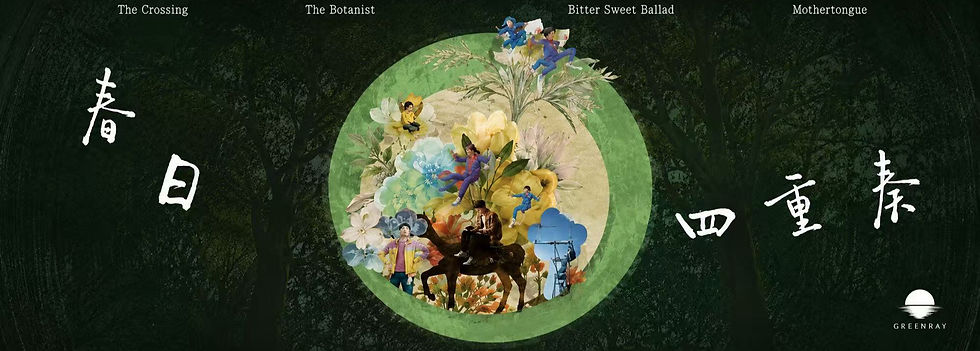

A spring rain makes us long once again for every fleeting moment of sunshine. The damp air, the briefly clearing skies, and the re-emerging light across the streets all remind us that spring is never a fixed season, but rather an emotional state shaped by awakening, movement, and change. Inspired by Mozart’s “Spring” string quartet, we conceived this screening programme around the theme of spring, using the structure of a quartet as its organising principle. For us, the true beauty of a quartet never lies in the solo of a single voice, but in the way different melodies respond to one another across their differences, pull each other forward, and ultimately complete a rich and complex narrative through dialogue and collision.
This is precisely how the four Chinese-language feature films selected for this programme — The Crossing, The Botanist, Bitter Sweet Ballad, and Mothertongue — resonate with one another. Through four entirely distinct narrative rhythms and emotional textures, they each respond to the motif of “spring”: the restlessness of youth, the growth of life, the lightness of romance, and the drifting nature of farewell.
Each film corresponds to a different movement within the quartet. The Crossing unfolds like a sonata, propelled by the restless momentum of freedom, edged with danger and urgency. The Botanist enters the vast landscapes of Xinjiang in the rhythm of an adagio, allowing lyricism to quietly emerge through stillness and everyday life. Bitter Sweet Ballad resembles a playful yet melancholic minuet, entering the sensitive and suppressed inner worlds of children while bringing rhythm and vitality into the weight of their reality. Mothertongue, meanwhile, completes the quartet with an almost gypsy-like creative spirit — fluid, lucid, and quietly charged with the tensions of lived experience.
We have chosen to screen these films in London precisely because the city itself gathers cultural memories and ways of seeing from across the world. The alternating rain and sunlight along the Thames reflect the different “springs” held within each viewer. These works by emerging Chinese-language filmmakers are not merely stories about the Hong Kong–Shenzhen border, the valleys of Xinjiang, the streets of Chengdu, or the outskirts of Beijing. They are also stories about growth, migration, belonging, and displacement — questions that remain eternally embedded in all of our lives.
Wherever you come from, perhaps you may still recognise within these films that uniquely spring-like feeling of restlessness, growth, and farewell. We invite everyone living in, passing through, or temporarily staying in London to enter this dialogue together: to let foreign gazes encounter Eastern images in the darkness of the cinema, and to let every voice within this quartet become complete through your listening.


